Declaration of beneficial owners
The declaration of beneficial owners is made to the Beneficial Owners Register (RBE), a database in which information on the beneficial owners declared by the entities referred to in the law of 13 January 2019 establishing a Beneficial Owners Register is stored. It is managed by the LBR, under the authority of the Minister of Justice.
This register contributes to the principle of transparency of legal persons by ensuring that information on the beneficial owners of legal persons is kept and made available.
Declaration of beneficial owners: available procedures
Reference documentation for identifying beneficial owners
Registering beneficial owners with the RBE: useful information
Which entities are required to report their beneficial owner(s) in the RBE?
The entities required to register their beneficial owner(s) in the RBE are those registered in the RCS, with the sole exception of merchants who are natural persons.
What is a beneficial owner?
A beneficial owner is any natural person who ultimately owns or controls the entity by virtue of owning directly or indirectly a sufficient percentage of shares, voting rights or equity interest in the entity. It is therefore up to the entity to carry out this exercise by first assessing who owns its capital and to what extent (a holding strictly in excess of 25%) and then verifying who controls it (via a preponderant voting right, for example). If, despite the search conducted, no beneficial owner could be identified, the senior management officials are considered to be the beneficial owner.
How to determine the beneficial owners?
Step 1:
- It is necessary to verify who holds the entity's capital and in what proportion (purely mathematical approach linked to the "capital ownership" criterion). If an individual holds more than 25% of the capital, he is presumed to be the beneficial owner. Therefore, this person is to be recorded in the RBE.
Step 2:
- It is then necessary to verify who has the power to control the entity (this time the analysis focuses on the criterion of "control"). For example, if an individual shareholder holds less than 25% of the capital but has a preponderant voting right, the latter is the beneficial owner and should be recorded in the RBE.
These two steps are carried out concomitantly and not successively or eliminatorily. If, despite the searches carried out, no beneficial owner could be identified, the senior managing official(s) is (are) then considered to be the beneficial owner(s) and must be registered with the RBE as such.
Who is the senior management official to be included in the RBE if applicable?
The notion of senior management official is to be understood in general as the legally prescribed management body and not just the chairman of a board of directors. The senior management official may also be considered to be the Chief Executive Officer responsible for the day-to-day management or any other equivalent body, appointed by virtue of legal or statutory provisions, in which case only the Chief Executive Officer is then to be registered.
When the body identified as the senior management official includes one or more representatives of the State, the Minister responsible for the public establishment is to be registered in place of the State representatives.
What supporting documents are to be submitted to the RBE?
In principle, no supporting documents should be attached. In some cases, supporting documents must be attached to the declaration form:
- A copy of an official document allowing to establish his identity, if the beneficial owner to be registered in the RBE does not have a Luxembourg national identification number.
- A duly motivated request for restriction of access to information, if the information of a beneficial owner is to remain non-public because of the risks to his or her person.
- A document certifying that the company has its securities admitted to trading on a regulated market, if the company for which the declaration is to be made is a listed company.
If supporting documents are to be attached, in which language should they be submitted?
Copy of the official document establishing the identity of a beneficial owner
- If the document is written in Latin characters, no translation is required.
- If the document is not in Latin characters, it must be accompanied by a translation into French, German or Luxembourgish. A free translation is sufficient; it is not necessary to have the document translated by a sworn translator.
Application for restriction of access to information of a beneficial owner and document certifying that the company is having its securities admitted to trading on a regulated market
- These documents can be presented in French, German, Luxembourgish and English.
What are the deadlines for making a declaration?
Generally speaking, the registration of beneficial owners must take place within one month from the time the registered entity became aware or should have become aware of the event that makes registration or its modification necessary.
Consultation of the Beneficial Owners Register (RBE): useful information
Can the public consult the RBE?
No. While the RBE had been open to the public since 1 September 2019, public access to the RBE was suspended on 22 November 2022, following a ruling by the Court of Justice of the European Union on the same date.
Indeed, this judgment, delivered in joined cases C 37/20 and 601/20, invalidated the provision of Directive 2018/843 of the European Parliament and of the Council of 30 May 2018 amending Directive (EU) 2015/849 on the prevention of the use of the financial system for the purpose of money laundering or terrorist financing and Directives 2009/138/EC and 2013/36/EU providing "that Member States must ensure that information on the beneficial owners of companies incorporated within their territory is accessible in all cases to any member of the general public".
How can the registered entity consult its data?
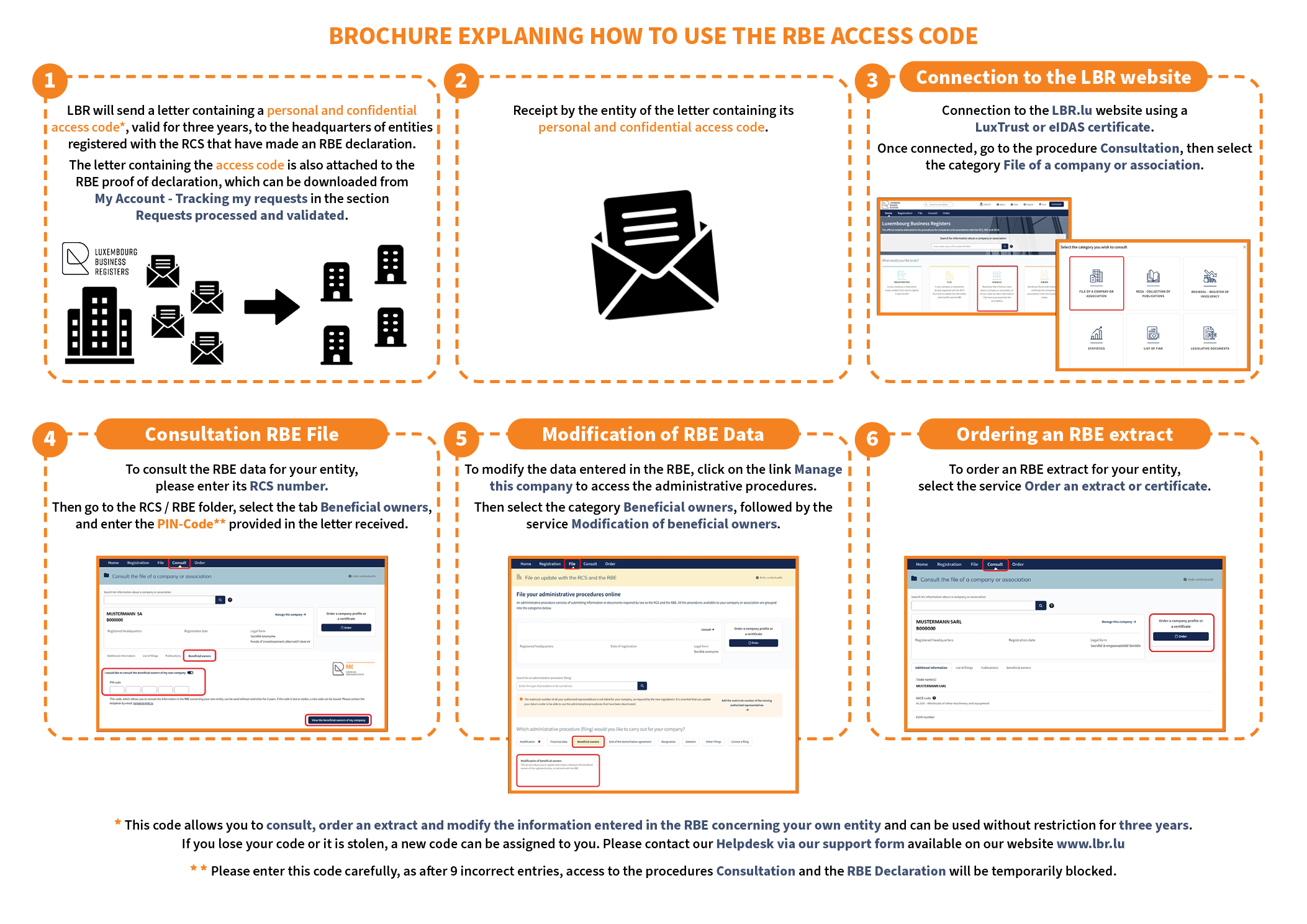
LBR has set up specific access to enable entities registered with the RCS to consult their own RBE data and order an extract.
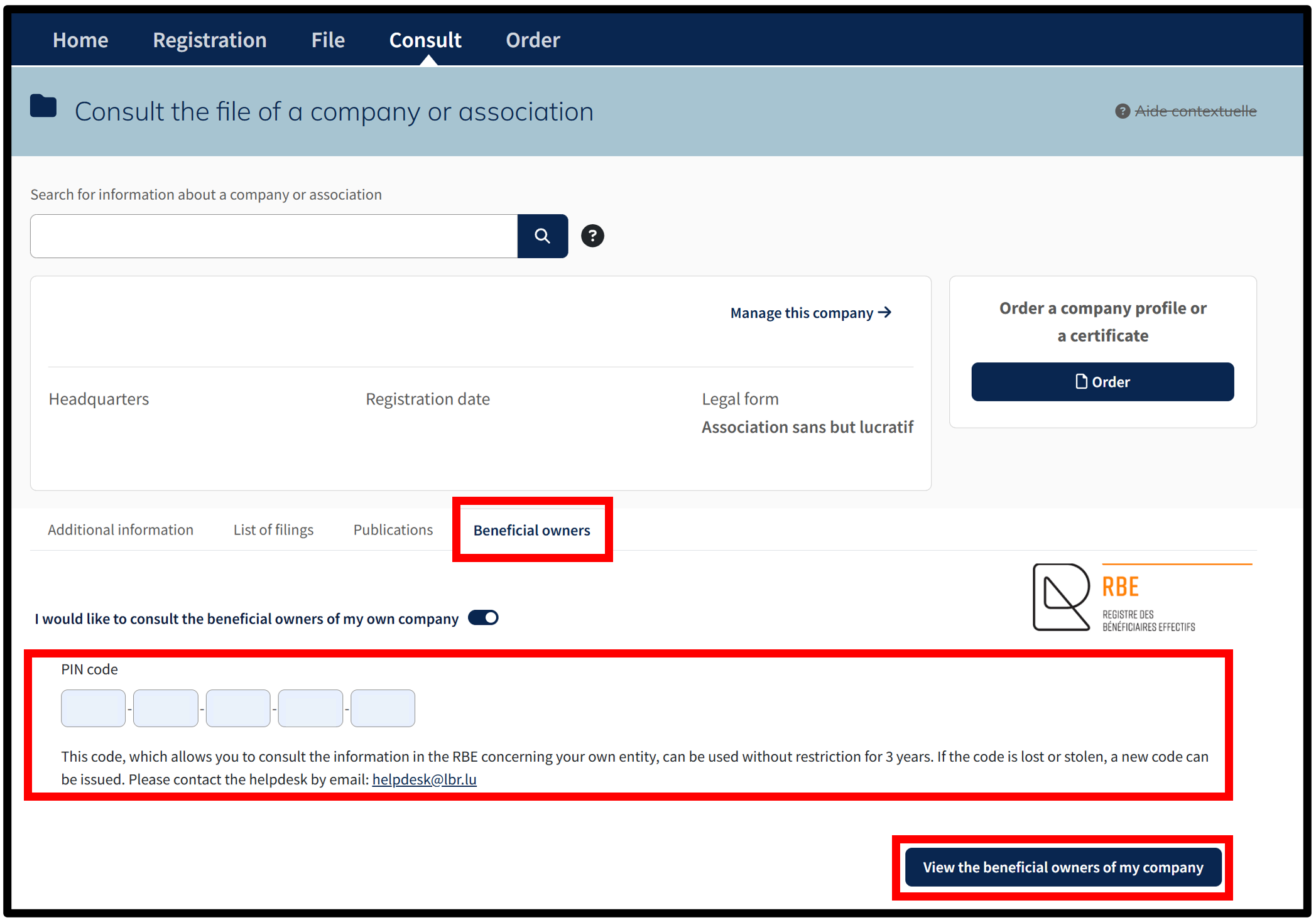
Entities registered with the RCS are sent a personal and confidential access code by post to their headquarters once their RBE declaration has been completed. The entity can consult its RBE file directly by following these steps:
- Select the procedure Consult
- Select the category File of a company or association
- Enter the RCS number of the entity
- In the RCS file of the entity, select the Beneficial owners tab
- Proceed with authentication using a LuxTrust or eIDAS certificate or the GouvID application
- Enter the personal and confidential PIN code that was communicated to the entity
- Once the information has been entered, click on View the beneficial owners of my company
The entity may order an extract (for a fee) from its own RBE file by clicking on the Order an extract or certificate service on the right-hand side of the page.
How can professionals subject to the modified law of 12 November 2004 on the fight against money laundering and terrorist financing consult the RBE?
Professionals subject to the modified law of 12 November 2004 on the fight against money laundering and terrorist financing have access to the RBE after signing an agreement with LBR or a one-off request form for access to the RBE. Two types of access are available to these professionals, depending on whether the exercice of their functions requires a regular or occasional need to consult the RBE.
A) Regular need to consult the RBE
Professionals who need to consult the RBE on a regular basis must:
- Be in possession of a LuxTrust certificate.
- Complete and sign the LBR agreement and technical annex (Pdf, 1.19 Mb).
RBE files can be consulted directly on the LBR website via the procedure Consultation, then by selecting the consultation category File of a company or association. For more information, please consult the help section RCS/RBE file - Consultation: Things to know. The professional will be able to order an RBE extract (for a fee) by clicking on the Order an extract or certificate service on the right-hand side of the page. Please note that other users (who also have a LuxTrust certificate) can be added to the account created via an access management application.

B) Occasional need to obtain an RBE extract
Professionals who need to consult the RBE on an occasional basis must meet the following requirements:
- Be a professional within the meaning of Article 2 of the modified law of 12 November 2004 on the fight against money laundering and terrorist financing.
- Be in possession of a product issued by LuxTrust SA or an eIDAS electronic certificate.
- Complete and sign the form requesting one-off access to the RBE (Pdf, 295 Kb).
- Attach a copy of the authorization of establishment.
An access request form must be completed and returned electronically to LBR with a copy of the authorization of establishment issued for the professional. The professional will not be able to consult RBE files directly on the website but will be able to order an RBE extract for an entity for which they require information. Any incomplete requests will not be processed and will be returned in full to the applicant.
What information can be consulted by professionals subject to the modified law of 12 November 2004 on the fight against money laundering and terrorist financing?
All the information recorded in the RBE concerning an entity may be consulted, with the exception of the address and identification number of the registered beneficial owners, as well as the information relating to a particular beneficial owner for whom a request to restrict access to his information has been accepted by the RBE administrator or is in the process of being assessed.
What is an RBE extract?
An RBE extract consists of a document issued by the RBE administrator containing the data entered in the RBE concerning an entity. The extract reflects the current status of the data entered.
What is a certificate of non-existence of beneficial owners?
If no information has been entered in the RBE concerning an entity, it is also possible to order a certificate attesting to this fact.
How to request an extract or certificate from the RBE?
A request for an extract or certificate is submitted via the LBR website. Only professionals subject to the modified law of 12 November 2004 on the fight against money laundering and terrorist financing may request an RBE extract or a certificate of non-existence.
Registered entities can also order an RBE extract containing their own data.
Are extracts and certificates subject to a fee?
These documents are subject to a fee. The amount is set by Grand-Ducal regulation.
In what form can extracts or certificates be issued by the administrator?
Extracts and certificates may be issued in electronic format or on secure paper format, bearing the electronic signature of the administrator.